Showing posts with label writing. Show all posts

Friday, January 08, 2010

Amazon Break Through Novel Contest


I received notification today that Amazon is sponsoring a "Breakthrough Novel Contest" for unpublished and self-published works. Details here.

Sounds like an incentive to plant the ass in the chair and write, hmmm?

Now why am I such a bastard about this sort of thing (Getting ass in chair and all that)? Well, it's because it's one of the easiest gifts I can give you - fun and happiness.

Here's the breakdown:

When you're creating something - you're having fun. Rest assured it's hard work - sometimes to the point of exhaustion - but when you get right down to the nitty and the gritty it's fun.

But even better than fun, is that moment when you actually finish something. That's called happiness. Boy is that happiness a sweet cocktail - far sweeter than fun.

In the current issue of Script (available at your local newsstand or bookstore) there is an article on "The Agony of the Unproduced" about people who are having the fun...

But have totally missed out on the happiness of having been produced. It's agony to work so hard on something only to lead to no result (that's not quite true as you do learn something from every script you write, but you understand the point I'm attempting to make here).

In today's world, there are so many different ways you can get your writing, art, music, video, design, whatever work out into the world... and you can feel the happiness in people who put it out there. There has to be happiness for creative endeavors to truly work.

So go get yourself a slice of happiness, and have fun doing it.

Edit to Add: And it just occurred to me that maybe... just MAYBE it might be a fun idea to hold a "pulp novel contest" of some sort duplicating the conditions under which an actual pulp novel was written: editorial/style restrictions, deadline, content, etc...
.
.

Thursday, October 01, 2009

This has Been My Experience As Well...

From Denny O'Neil at Bleeding Cool :

Sorry. Writing is self-taught. You acquire the skill by applying the seat of your pants to a flat object and moving a stylus across paper or tapping a keyboard, and you continue to do that until someone begins paying you to do it, and then you spend the rest of your life teaching yourself how to do what you’re doing. It is often a lonely life–you can get help before and after, but not during–and if the notion of closing a door behind you and manipulating verbal and visual language for many hours every week is abhorrent to you, then perhaps you would be happy applying your skill and intelligence and enthusiasm elsewhere.

--------------------------------------

Add to this that life is going to get in the way, try to derail you at every turn, and will sometime succeed for the moment. But if it wins in the end and you stop writing don't whine. You weren't a writer. It's all right.

But if you keep getting up off the mat and get back in the fight then you need to work on your one-two combination and your upper cut.


Monday, July 13, 2009

What Should I Write?


Story courtesy Strange Horizons via Boing Boing.

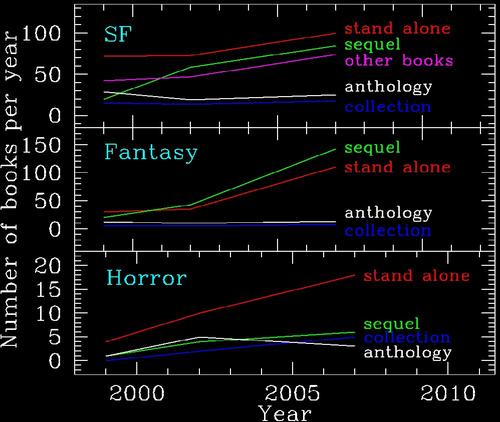
If you read the statistical analysis of this it will make your eyes bleed polynomials so I'm going to break this down to show the trends occuring in genre fiction.

SciFi:

Stand Alones, Sequels and Other books (factual books on science fiction, art books, etc) are trending upward or are stable. Collections and anthologies are going flat. Unless some smart person has a new way to present the anthology or collection...hmmm.

Fantasy:

Stand alones and sequels dominate.

Horror:

Standalones and sequels rule the abattoir here. Short fiction anthologies are actually trending down.

Looking at # of books published per year:

Fantasy
Science Fiction
Others
Horror

(Please go to the Strange Horizons link above to see the more detailed analysis and charting)

I would be interested in seeing a similar analysis performed on online book services (IPhone, Kindle) and Print On Demand publishing to further refine this data. Media distribution does make a difference, and I suspect (though can't confirm) there's more short fiction potential in those arenas (for what I'm going to assume are obvious reasons at least to this audience).

Wednesday, April 22, 2009

Marketing 101: The "Qualifier" No-No

I am revising a company's website copy - repositioning them in the market - and I keep running into qualifiers. Qualifiers are those words or phrases that kneecap a success by making it "not-so-great."

"It's the best show featuring a monkey."

"It's the direct-to-video hit comedy."

Notice how in both those statements the phrases take "the win" down a peg? You don't ever want to do that. Ever.

Because people are out there who are going to (try and) take you down a peg anyway.
Why help them out?

When you're pitching, remove the qualifiers...
[It's this little movie we did...]
When you're writing, remove the qualifiers...
[He kind of loves her...]
When you're designing your key art, remove the qualifiers...
[If I see another grey, formless piece of crap key art I'm gonna kill the slowest of the bunch of ya]

Because when you apply qualifiers to your work it says you don't believe in your work, it says that it's half-ass work and it says you're half-ass. NOT to be taken seriously.

Life's too short to be half-assed. Especially in this business.

Thursday, April 02, 2009

Be in a Frenzy...


Jill Golick reminds us that Script Frenzy has started...

If you need and excuse to bang out a first draft this is it. Structured in a similar manner to NaNoWriMo (sp?) it aims to get as many people as possible over the hump of writing the first draft of a script.

So go sign up... and write.

Saturday, February 21, 2009

I'm Writing...


Pitches: for a pulp anthology featuring [REDACTED].

A Proposal: for [REDACTED] to [REDACTED]...

A Business Plan: which is taking longer than expected, and is really frustrating at times, but is ultimately really cool and so worth it. More info contained in the Pulp Legion Electrogram.

A Screenplay: which means my next 30-45 evenings will be locked up. Again, more detailed info in The P.L.E.

The Pulp Legion Electrogram: trying to figure out what to include and what not to in this inaugural issue.

Now I'm off to write some emails as I have to follow up on some work...

See you in the Mental Ward.

Thursday, February 12, 2009

Pulp (Screen) Writing...

Pulp screenwriting is dependent upon so many things that are beyond the writer's ability to control - the production's talent, organization, vision - that when it comes to delivering a screenplay to your producer you always have to remember to a) make it entertaining, and b) make it bulletproof.

Now the first one is easy if you have talent and storytelling chops -- the craft of it all.

But the latter is where many new screenwriters get hung up. They want to jam pack their story with so many - characters, ideas, FX, locations, you name it - that they paint their script with a target and hold it up for the producer to take shotgun blasts at it.

I've always been an advocate of keeping it simple. One idea taken to its logical extreme rather than 50 ideas all crying out for attention in the "script-nursery." One of the areas where I think writers tend to shortchange themselves is in thinking that way - that they have to generate a ton of ideas in order to make the world they've built within the script "real" enough.

What they are really doing is drawing attention away from what should be the focus of your script - that one idea that is so cool it carries the story on its shoulders through that marathon of 96+ pages. So forget the "mosaic" or "cornucopia of ideas" approach to writing and stick with what works, what makes your story better.

In pulp storytelling - comics, prose or film - the story you are telling doesn't have to be "real." It just has to be real within the context of the story you are telling. That gives you a lot of room to explore that one idea you have that sparked the story in the first place. It gives you a lot of room to stylize and enhance that one idea rather than having to stylize and enhance 50 ideas, some of which are probably working at cross-purposes from one another.

In pulp storytelling - you want clarity and entertainment value. Again, that one idea that is turned on its side and looked at from a new perspective. That one idea that will resonate like the single note held by an opera singer's voice, instead of the crashing din of a thousand singers each singing a different tune. Each trying desperately to be heard above the rest - but to no effect.

But really - don't just listen to me about this. Go read Steven Grant's latest column at Comic Book Resources. He discusses the comics of "Mad Ideas" but really it's all the same thing - pulp.

If you want to amp up the value of your screenwriting - that is, get it sold - then switch up your strategy and start focusing on one idea you can explore instead of twenty ideas you can jam into your script because they are cool.

Because a producer is going to be able to shoot a script that explores one idea really well, and he's going to reject anything else.

Thursday, January 08, 2009

Saturday, December 20, 2008

Writers Write...No Matter What

Our friend, Lee Goldberg has a wonderful profile on prolific western (and other genres) writer James Reasoner:

"At one point in my career, I had published more than eighty books, only one of which (TEXAS WIND) had my name on it. People used to ask me how I could write a book knowing that my name wouldn’t be on it, and my stock answer was “I don’t care if my name is on the book as long as it’s on the check.” Of course, that’s not exactly true now and wasn’t then. I’d love to be able to just write what I want, sell it, and have my name on it. But being able to keep writing, period, is more important to me."

People have asked me recently when they are going to see a new movie or TV or web show with my name on it, and my answer is generally the same as Reasoner's -- I'm too busy getting paid for my other writing!
And yes, it's sometimes disconcerting that other people are sometimes credited for my work, but that's part of what I get paid for - making it seem like it's the other guy's or company's work. And if the check clears - then I have no problem with my name not being on the cover (or the website, or email blast, or casewrap, or poster, or animation).

You either write or you don't. There is no try. There is no "I only write [insert medium here]"

Now if you'll excuse me, I have to quit procrasti-blogging and get over to writing.


Monday, October 20, 2008

Just Sent Off a Story...

And it feels good.

(Not as good as sex,but exhilarating nonetheless)

That's the way it happens sometimes - you hold your child's hands until the very last minute then shove them out the express train door...

(I imagine this is very much how my parents felt when I went off to college: "We love you, Son!" followed by a size 12 boot to my posterior)

And now I'm free... only I'm not. Lots and lots more to do:

A web serial to write...
An online business plan to write...
Another business plan to consult on...
Revise some literary and artist agreements...
Revise a short story...
An online animated short to conceive and write...
Not to mention my "to read" pile that I now HAVE to tackle.

(Now where is that bottle of scotch?)

Thursday, October 02, 2008

A Modest Proposal Indeed

Anne Thompson's Variety blog has a guest piece by former 25 year agent Nancy Nigrosh, who in Swiftian fashion takes the Hollywood writing/development process to task in what she calls her "parting shot."

"Why is it so ingrained in Hollywood that one person alone cannot write a producible screenplay?

The Writer's Guild Of America's 2007-8 strike was supposed to be about a bigger piece of the pie for the future distribution of a writer's produced work… the pie in the digital sky.

But the real truth is that the actual day –to- day script development process based on writer elimination has created the real strife. Historically this practice has led to the cyclical bloodletting every time the guild’s contract with the buyer /employer gang known as the Association of Motion Picture and Television Producers, expires. If something doesn't fundamentally change, there will be more strikes in the future, as each contract expires, creating a negative cycle of meltdown Hollywood and its doting mama, California, can ill afford."

The rest can be found here.

Thanks, Nancy. I agree with everything you say, and I'm sorry that your piece here is your swan song from the industry. While I don't want to turn my back on "Hollywood", I am devoting more time to building my own entertainment house and reaching my readers/viewers directly.

I won't be rewritten, unless I decide otherwise.

(and in the near future I am developing a way for us to collaborate)

Saturday, August 23, 2008

Jane Talks The Pulp

Jane Espensen talks about the new BSG TV Movie (aka D2DVD Movie) and cutting the script down to run in the time allotted:

"I just did a rewrite pass in which I cut twenty-four pages of script (from 113 to 89 pages total). It's incredible what you can do when you have to. Now, if you have to cut nine or ten pages from a two-hour script, you can probably do it with trims. Lose some scenes that can be moved off-screen, trim the fat off the ones that remain, and you can probably get there. But if you are in serious length trouble, and especially if you've already trimmed to the bone, you have to look at story. The trick here is to be open-minded. The things that get cut may include a part of a story that you think is absolutely necessary. It's okay. Put it all on the table."

No offense to Jane (who has a far better career profile at this point than I ) but she's having to cut because the script wasn't designed to run in the time allotted. That wastes time and effort and cuts down on production's momentum.

There's a better way.
The way to pack as much story into it as possible without blowing the budget or schedule.

Part One.

Part Two.

Part Three.

Part Four.

Seriously, by going into the process knowing that you only have 90-95 pages for your script you are freed. You are free to be as creative as possible to get as much cool story into your script as possible (visually), and discard the stuff that's "filler" (unnecessary dialog, scenes). You are free to make every moment count for something (read "is entertaining") and quickly immerse the audience into all the cool, interesting bits of the story and characters (unlike the show example here).

It's the pulp way.

Monday, July 28, 2008

What A Nice Surprise!

I am back from Comic Con sans crud and I am cleaning out my personal email box. I am going through it all and lo and behold I read Warren Ellis's BAD SIGNAL with his take on Dr. Horrible which I will reprint here (with my commentary) :

bad signal
ME

NOTE: [REDACTED]

NOTE2: [REDACTED]

So, Dr Horrible, then. I only watched the end of it,
because, as much as I love Joss, I hate musicals.
Musical comedy makes my balls itch, frankly. And
no-one wants that.

But it was a lovely little production. Neil Patrick
Harris and Nathan Fillion are always watchable,
and some of the non-musical gags were inspired.

Not interested in the fanwank about the ending,
nor in Dr Steel losing his shit, so don't even
think about bringing me any of that. You'll go
right into the spam filter.

Most interesting to me, though, are the guts of
the idea. Joss Whedon blowing his savings
account on staging a 45-minute serial for the
internet (that will doubtless prove to be i2dvd --
internet to dvd -- apologies once again to Bill
Cunningham for perverting his "d2dvd" coinage).

I am excited to be the object of your perversion, Warren.
Though I wish I could take credit for the name, D2DVD and DVD Premiere
were created by other folk. I only popularized them.

I like that Joss and others (Strike TV) are working on stuff they
own. His financing it himself is Joss taking responsibility and
ownership of his property. Independent exploitation guys have been doing
it for decades, and its nice to see that Joss, et al are seeing and
utilizing the business model.

I was crapping away in the website the other day
about the ratio of linkblogs to people actually
producing original content. And then Joss blows
a couple hundred grand on not only producing a
bit of original content with unusually high
production values, but also an Internet Event. It
was free to view if you attended within a stated
time window. It was in fact Appointment Internet.

I think that was entirely the point - use the web for what its good
for - connecting large amounts of folks to a property or discussion -
to generate the publicity for the eventual DVD release. A wonderful
stunt that adds value.

And while there are elements of the project that
only someone of Joss' position could pull off --
the money, the cast, the values, etc etc etc --
I think there are still lessons to be taken from it
that apply broadly. Not least of which are, Be
Short, Be Bold, and Get It Done.

Amen.

I can't tell you how many new hopeful comics
writers I meet who have never finished anything
in their lives because their intended first project
is a hundred-episode epic that creates a whole
new universe or three. And I tell them all the
same thing: you're screwed. No-one will want it.
Not until you've written something short, capable
of being produced on a budget, and finished.

And as many of these guys that are in comics, there are just as many
in film, which is frankly a harder row to hoe. More manpower
required to get something done.

Your epic may be world changing, but no-one will
ever know because no publisher will gamble that
kind of money on an unknown. And that's before
you get to the vagaries of the attention economy.

Online is a) your portfolio of work and your b) opportunity to sell stuff
to pay for it. Part of the business plan has to be bringing in the revenue
and part of that revenue is the attention you get in the right circles.

Production values are nice, but not necessary to
producing compelling work.

I kind of wish people would quit using the term production value
and go with the term "style." You need to develop your voice, your perspective,
your style.

People gave Dr Horrible 15 mins because it's Joss, but five minutes
is a great length for net video. 500 words, 5
pages, whatever. Be short. Be great.

Again, amen.

And if you can get an evil horse in there, that'd
be good, too.

-- W

Sunday, July 13, 2008

Flashpoint: On Target?


So, like many of you across the United States and Canada on Friday night I watched CBS / CTV's FLASHPOINT starring Enrico Colantoni, Hugh Dillon and Amy Jo Johnson.

Denis comments about the premiere here.

Aintitcool News
collates a half dozen or so reviews here.

I like the show. I do - just not a lot. I can take it or leave it, but...

I wanted to love this show because I am their demographic. I used to be in the military, and I have a respect and understanding of guns and their (mis)uses. I also live in a big city which has a lot of crime and intensity. I like crime shows.

The problem (I have) is that as well-produced as this show is, there is an underlying current of "scratch the surface only, don't go too deep into the characters" here that is disappointing. It speaks to missed opportunities to unify the separate plotlines and characters of the story and really leaves you wanting more (but not in a good way). Let me explain my thoughts on this because there's going to be some "but what about..?" from the audience. Fair enough.

From the CBS website:

FLASHPOINT is a drama that depicts the emotional journey into the tough, risk-filled lives of a group of cops in the SRU (inspired by Toronto's Emergency Task Force). It's a unique unit that rescues hostages, busts gangs, defuses bombs, climbs the sides of buildings and talks down suicidal teens. Members of a highly-skilled tactical team, they're also trained in negotiating, profiling and getting inside the suspect's head to diffuse the situation to try and save lives.

(emphasis mine)

Edit to add/correct/rant: CBS, it's "defuse" not "diffuse." The last thing you want in a hostage or bomb situation is to "make it cloudy" or "spread it out." The copywriter who wrote that should issue you a refund, and you can forward it to me. You're welcome.

This is an important point (to me) because at no time do we really "get into/access/ feel" that we get inside the heads of our team, and we didn't really get inside the head of our Croatian hostage-taker to find out exactly why he's doing what he's doing. We get glimpses to be sure, but they are fleeting, insubstantial things and to paraphrase writers/creators of television:

Television is about our characters and many different stories involving them.

That's the problem - I didn't feel involved - and I really wanted to be.

We have as our lead character negotiator Greg Parker (Enrico Colantoni - VERONICA MARS, JUST SHOOT ME, GALAXY QUEST) and he is the lynchpin of the group. Unfortunately we never see him perform that function to any great degree within the team.

Remember HILL STREET BLUES and Captain Frank Furillo? Everyone came into his office at one point or another - with a case, with a personal problem, with administrative crap. He was the touchstone for every character in the squad room of Hill Street Station. Look at THE SHIELD and you see how Vic Mackey interacts with every member of his team, and is the buffer between the Captain and his unit.

You became involved with and understood Furillo and Mackey as they made their way through the day and interacted with all the people in their lives and jobs.

The problem with FLASHPOINT is that GregParker only performs this function with Hugh Dillon's character and no one else. He isn't the center of the show and as such doesn't allow us access to all of the other characters. He is underused.

Is that really how you treat the star of your television show?

I also have a problem with how the main cast interacts with the guests. I would have really liked for Hugh Dillon's character to have more of a relationship with the Croatian hostage-taker. I think they were trying for a "other side of the same coin" feel there, but they didn't succeed. If they had succeeded there would have been much more resonance to the shooting and the consequences.

That's got to be the premise of the show - how there are consequences to our main characters in having to deal with these high tension situations. We want to get involved with this group. Add the fact that the team is changing - and thus the dynamic is changing should have involved me.

It didn't.

There was no razor-sharp, laser-intense drama there. There was a muted sense of drama that again didn't pull me in.

Let me, for a moment anyway, compare FLASHPOINT with LEVERAGE. Two different shows with two very different premises, yet both deal with teams (and their quirks and problems) and their leaders (who have their own quirks and problems) and resolving high tension situations.

The difference between the two is that LEVERAGE interacts with its characters, pulling them into one another like sub-atomic particles -- colliding, generating energy -- all around the nucleus of Timothy Hutton's character, Nate Ford. Those particles each have their role to play and Hutton's character plays them all beautifully - that's what he is initially hired to do -- by the guy who plays him!

In FLASHPOINT we have a nucleus of Greg Parker, but those particles - his team - aren't revolving around him. They seem to be in their own space -- not colliding with one another -- but smoothly running parallel. And when one of those particles does collide with the guest that week, it isn't in a truly meaningful, resonant way that speaks back to Greg Parker and his leadership of the team.

It's JUST another sad case that unfortunately had to be resolved with violence... and of course, Hugh Dillon goes home and hugs his kid. [cue violins] If he had gone home and slapped his wife the way the Croatian man had - then you would have had a moment. The same sort of moment you had when Frank Furillo went home and took a bath with the beautiful, outspoken, tough-as-nails defense attorney who was getting on his case that day. The same sort of moment you had when Vic Mackey turned around and shot one of his team because he was a rat.

Again I wanted more from this show. It has the research and procedural down cold... but it needs a heart, a center and some serious emotional collision in order for this show to be something other than just a muzzle flash on Friday nights. It aimed for the surface and it ricocheted off into the nether.

Too bad - it could have been a killshot.

Wednesday, July 02, 2008

If...

A certain person (who shall remain nameless) were to write, design and publish a book on say...pulp filmmaking then:

1. What would you want to see in said hypothetical book?

- writing info.
- shooting info.
- production and post production work-flow tips.
- marketing and distribution.


2. What supplementary material would you like to see?

- a DVD (ala DV Rebel's Guide) .
- A chat forum exclusively for those who have purchased the book.
- Charts, tables, sample budgets.
- a script.
- Interviews (and with whom?)


3. What isn't being discussed in books that needs to be?

Everyone discuss .

Sunday, June 29, 2008

All This And The Kitchen Sink...

Captain Jack, Ianto, Gwen, Sarah Jane Smith, Martha Jones (and Mom) , the former Prime Minister, The Rhino aliens, The Shadow Proclamations, Rose Tyler and...

The D word...and let's not forget -- the R word too!

When Russell T. Davies leaves a show he makes it an event. That's for sure.

Whew!

Friday, May 30, 2008

Evolution of a Pulp Writer...

(And yes, sometimes I do sit naked like that and type...what? Why are you looking at me like that?)

Friday, May 16, 2008

What He Said...

"I write for fanboy moments. I write to give myself strength. I write to be the characters that I am not. I write to explore all the things I’m afraid of. I write to do all the things the viewers want too. So the intensity of the fan response is enormously gratifying. It means I hit a nerve. "

--- Joss Whedon

(Tip o' the hat to Jill Golick)

Thursday, May 15, 2008

Storytelling Tips We Can All Learn From Metallica

I am still tired from last night's show because it was chock full of the awesome. My ears are still ringing, and the mad pulp bastard is acting like the old, slow bastard.

Such is the price we pay for rock n' roll.

Last night as we rocked out, it occurred to me (because this is how my brain works) that the best rock n' roll songs are stories, and the best concerts are novels with each song being a chapter. With that nugget of insight, the following are my further observations on "story" by way of Ulrich, Hettrick, et al...

1. COME IN SWINGING:

The guys started the show with a rapid-fire head-banging tune that got the audience quickly off their feet and into the experience. They also came in late, which built the expectations up in the audience to a fever pitch.

2. CONCENTRATE ON THE ESSENTIALS:

This was a stripped down show. Three guitars, a drum set and amplifiers on a sparse black curtained stage. The amplifiers were set up so that the readout panels with their glowing diodes and LCD's providing a line across the back of the stage and defined the space.

And truly that's all that was required. The rest was audience and creators...

3. CONNECT WITH THE AUDIENCE:

Even though the band was separate from the audience they consistently asked questions, got feedback, threw stuff into the crowd and roused everyone to cheer and rage. They always made sure to go back and reconnect somehow with every new song.

4. STORYTELLING IS A COMMUNAL EXPERIENCE:

Stories are meant to be shared and spread. People texted with their phones. My date Twittered the whole thing.

And of course, there's the YouTube:


5. GIVE THEM WHAT THEY EXPECT:

Lots of classics thrown in there - Enter, Sandman - One - Sad But True...

6. BUT NOT EXACTLY HOW THEY EXPECT:

As you can see they flipped up a classic song by adding Flea to their mix (which was a good fit). They worked new songs into their playlist, changed guitars up, changed the arrangements. They played on everyone's expectations and brought something new to the table.

Storytelling is a lot like Rock n' roll. The good stories are memorable and leave your ears ringing the next day. The great ones inspire you, and make you question how they were constructed.

Or is this all that gin talking?

Friday, April 11, 2008

The Pulp Writer's Warm-up...


I am a pulp writer...

My laptop is my chisel, my desk my workbench. I use them to chip away at the block of stone (or wood or clay) that we call Story.

I write even when I don't want to because I know that when I write I am at my best and most creative. The doing leads to the inspiration.

I write a lot and I write everything I can: short stories, comics, screenplays, plays, articles, etc...because it makes me a better writer.


(Beautiful art by Sean Phillips of Criminal fame)

I bring everything that I am to my work - my thoughts, fears, strengths, weaknesses and my experience. My writing is a reflection of who I am and how seriously I take my craft even when the deadline is Tuesday.

My first job is to entertain. Everything after that is frosting.

Now that my fingers are warmed up... time to hit it.